
What does “login” actually buy you on OKX, and where do verification levels, spot trading features, and wallet types intersect — or pull you apart? That question reframes a routine task (sign in) into a decision problem that matters for safety, fees, and trading options. For US-based traders who browse price charts, test strategy ideas, or juggle DeFi and NFTs, the route you take from clicking “okx login” to placing an order determines what you can do, how fast, and how much risk you accept.
This article compares three linked but distinct choices: the account identity and verification path (KYC), using OKX for spot trading (including spot vs margin nuances), and selecting between OKX’s custodial accounts and the non-custodial Web3 wallet. I’ll explain mechanisms, show trade-offs, correct common misconceptions, and end with practical heuristics for different trader profiles in the US regulatory and operational context.
How verification (KYC) actually works and why it matters
Verification on OKX is not cosmetic: it gates capabilities. Mechanistically, KYC requires you to upload a government-issued ID and complete a facial-recognition liveness check. That input is checked against anti-money-laundering rules and regional compliance settings; the result is a verified identity flag that the platform uses to allow higher deposits, fiat onramps, certain derivative products, and sometimes higher withdrawal limits.
Three practical implications follow. First, without KYC you’ll face operational limits — smaller fiat flows, restricted access to fiat rails, and sometimes inability to use margin products. Second, KYC creates a custody trade-off: you unlock the convenience of instant on-exchange settlement and custody protections (including cold storage), but your identity data is held by the exchange and linked to on-chain activity carried out within that account. Third, in the US context, KYC is increasingly non-negotiable: regulatory frameworks push exchanges to verify users to access many higher-risk tools.
Common myth vs reality: some traders assume that avoiding KYC preserves privacy and safety. Privacy from other market participants, perhaps; but avoidance often means losing access to essential services (fiat deposits, higher limits) and having to rely on riskier alternatives (OTC trades, smaller unregulated venues) that carry counterparty and liquidity risks. The better question is: which verification level delivers the capabilities you need for the least marginal privacy loss?
Spot trading on OKX — what works, what’s limited, and where margin fits
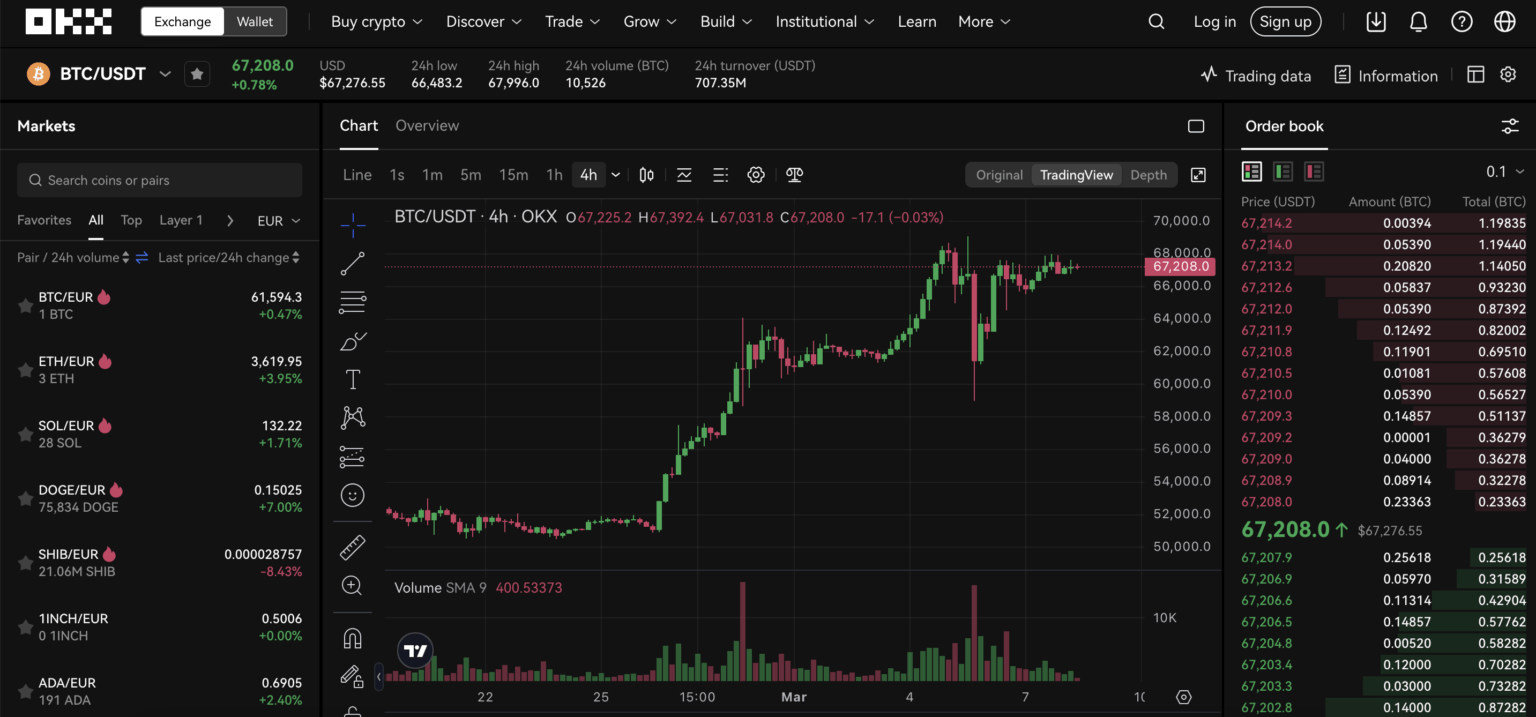
Spot trading is the simplest way to exchange one cryptocurrency for another at the current market price. Mechanically on OKX, it uses the order book: limit orders sit in the book; market orders sweep existing liquidity. For US-based traders the familiar advantages apply — immediate settlement, transparency of holdings, and straightforward P&L. OKX supports over 300 assets, so the platform can host pairs you might want to pair for quick rebalancing or deposits.
Where trade-offs enter: liquidity and delisting. OKX routinely adjusts the set of trading pairs; recently, the exchange delisted a number of niche tokens as part of ongoing housekeeping. For you, that means trading strategies relying on low-volume or fringe tokens may be interrupted by delisting notices — a liquidity risk that creates forced exits at unfavorable prices. Always check pair liquidity, depth, and recent trading volumes before committing significant capital.
Margin trading on OKX borrows funds to amplify exposure (up to 10x for some spot-margin modes). The mechanism: collateral you supply backs borrowed funds; liquidation engines close positions if maintenance margins are breached. Margin amplifies returns and losses and adds a tail risk of forced liquidation in volatile US-centered markets. If you’re a part-time trader or primarily US-tax resident focused on capital preservation, margin may materially change your risk profile in ways that simple spot trading does not.
Custodial vs non-custodial OKX wallets — control, recovery, and operational risk
OKX runs both custodial accounts (the exchange holds keys) and a non-custodial Web3 wallet (you hold the seed phrase). Those are fundamentally different security and user-experience models. Custodial accounts simplify recovery (the exchange can assist with account restoration tied to your verified identity) and provide the benefit of cold storage protection: OKX keeps over 95% of assets offline in multi-signature air-gapped cold wallets. That reduces large-scale hacking risk, but it does not eliminate client-level risks like phishing or account credential compromise.
Non-custodial wallets restore a different set of trade-offs: you control private keys and thus are immune to exchange insolvency or custodial freezes, but you assume full responsibility for backup and recovery. Lose the seed phrase and access is permanently gone. Moreover, interacting with DeFi via a non-custodial wallet exposes you to smart-contract risk and potential exploits; OKX’s DEX aggregator can help find efficient swap routes, but the contracts you interact with still carry independent risk.
In practice, many experienced traders use a hybrid: keep bulk reserves in custodial cold storage for peace of mind and liquidity needs, and tract smaller amounts in a self-custodial wallet (optionally hardware-backed) to interact with DeFi or to hold “permissionless” assets. The right split depends on your threat model: are you most worried about exchange custody failure, regulatory freezes tied to KYC identity, or phishing and device compromise?
Decision frameworks: which path to pick for common US trader profiles
To make the comparison concrete, here are three heuristics to reuse.
– Casual spot trader who wants low friction: verify identity to unlock fiat rails and fiat-to-crypto pairs, use custodial accounts for deposits, enable 2FA and biometric app login, and treat spot trading as your primary execution layer. Reason: convenience and recovery options outweigh the marginal privacy cost.
– Active trader who uses margin and derivatives: complete full KYC, set conservative leverage caps, use isolated margin where possible, and maintain a separate non-custodial wallet for DeFi tests. Reason: regulatory-compliant identity reduces withdrawal friction; isolated margin bounds risk to a specific pair instead of your whole balance.
– DeFi power user / NFT collector: favor a hardware-backed OKX non-custodial wallet for on-chain interactions and minting, but keep fiat and large reserves in custodial cold storage. Reason: decentralized control for permissionless activity, custodial security for capital preservation.
Operational checks and limits — an honest look at where systems break
Two failure modes deserve attention. First, identity friction: KYC systems can be slow or fail liveness checks for innocent reasons (lighting, camera quality, travel documents). That delays access to funds or trading tools and is a practical operational cost often ignored. Second, market-level risk: delistings and liquidity evaporation can strand positions or force sales; delistings are routine and a governance tool exchanges use to maintain orderly markets. Both points suggest a readiness posture: do not leave operationally critical positions or settlement needs solely dependent on one verified account status or one thinly traded pair.
Finally, security trade-offs remain. The exchange’s Proof of Reserves provides on-chain transparency about backing, but it doesn’t protect individual accounts from phishing, nor does it reduce counterparty risk if you route funds off-platform. Similarly, cold storage lowers systemic hack risk but increases withdrawal latency and imposes operational procedures for large moves.
What to watch next (near-term signals)
Watch three things that will change the calculus. One: regulatory shifts in the US about stablecoin flows and on-ramps; tighter rules could change which KYC data is required. Two: liquidity management: expect periodic delisting of low-volume tokens; if your strategy depends on niche tokens, track delisting notices closely. Three: interoperability improvements in the OKX DEX aggregator and hardware wallet integrations — broader hardware support reduces the friction cost of non-custodial setups and could nudge more traders toward hybrid custody.
If you want to proceed to sign in and review options, start from the official entry point: okx login.
FAQ
Do I have to complete KYC to spot trade on OKX from the US?
Short answer: you can trade some spot pairs with limited functionality before full KYC, but meaningful fiat onramps, higher withdrawal limits, and margin/derivatives access require identity verification. KYC is increasingly required for higher-risk features and larger flows due to AML rules.
Is the OKX Web3 wallet safer than a custodial account?
Safer for what? A non-custodial wallet is safer against exchange insolvency or custodial freezes because you control keys. It is less safe for users who do not securely back up seed phrases or who frequently interact with unvetted smart contracts. Custodial accounts provide recovery options and cold-storage protections but add counterparty and identity-linked risks.
What are the practical signs that a token might be delisted?
Look for sustained low trading volume, widening bid-ask spreads, reduced market maker activity, and formal exchange notices. Exchanges often announce delistings in advance; nonetheless, prepare exit plans for thin assets since delisting timelines can be short.
How should I split funds between custodial and non-custodial storage?
There’s no universal split. A common heuristic: keep your operational trading capital and short-term liquidity on a custodial exchange account (enough to execute strategies without repeated withdrawals), and hold longer-term or experiment capital in a non-custodial wallet protected by hardware keys. Adjust the split based on trust, technical skill, and recovery discipline.